
IELTS speaking test preparation in London in 2026 is shaped by one fact that is easy to miss in all the coverage of paper tests ending and computer delivery replacing them: the IELTS Speaking test has not changed. While Listening, Reading and Writing moved to computer delivery and paper IELTS ends globally on June 27, 2026, the Speaking component remains a live, face-to-face interview with a certified IELTS examiner. It always has been and it still is. IELTS speaking test preparation in London therefore requires a fundamentally different approach from the other three skills: no app, no practice paper, no screen simulation replaces talking in English with a real person under real assessment conditions.
What The IELTS Speaking Test Actually Involves
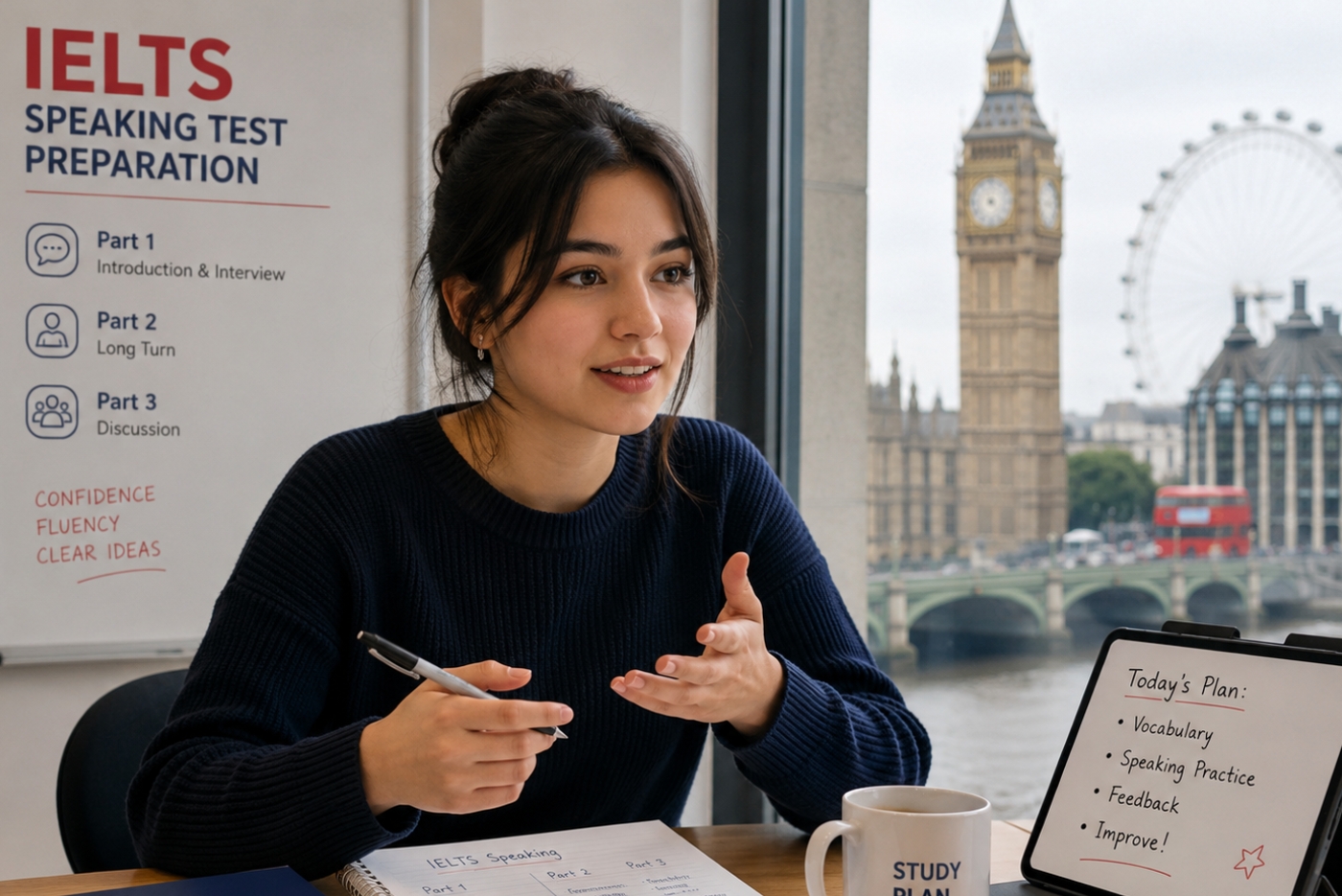
IELTS speaking test preparation in London must begin with understanding exactly what the examiner is assessing. The official IELTS Speaking format guide at https://ielts.org/about-ielts/ielts-test-format/speaking describes a structured 11 to 14 minute interview in three parts:
Part 1 runs for 4 to 5 minutes. The examiner asks questions about familiar topics including your home, your studies, your daily routine, hobbies and interests. This part assesses fluency and coherence, vocabulary, grammar, and pronunciation in a controlled conversational context. Most students feel most comfortable here.
Part 2 runs for 3 to 4 minutes. The examiner gives you a task card with a topic and bullet points. You have one minute to prepare and must then speak for 1 to 2 minutes on the topic. Common prompts include describing a person, place, experience or object. This part assesses extended speech and the ability to organise information independently without the support of an ongoing conversation.
Part 3 runs for 4 to 5 minutes. The examiner asks more abstract, analytical questions related to the Part 2 topic. Questions move from personal to societal: from “describe a time you learned something difficult” to “why do you think people find it important to keep learning throughout their lives?” This part assesses the ability to express and justify opinions, speculate, and discuss complex ideas in English.
IELTS speaking test preparation in London needs to address all three parts differently. Part 1 needs fluency and confidence. Part 2 needs structure and the ability to sustain extended speech. Part 3 needs advanced vocabulary and the ability to handle unexpected analytical questions without deflecting or giving one-word answers.
IELTS Speaking Test Preparation London: What Most Students Get Wrong
The most common mistake in IELTS speaking test preparation in London is practising with apps or written materials rather than with people. Speaking is the only IELTS skill where the preparation medium and the test medium are identical: talking. Every hour spent reading about IELTS Speaking strategies is an hour not spent actually speaking English. The skill develops only through practice in the specific format, which means speaking for extended periods, responding to unexpected questions, and recovering from errors in real time.
The second most common mistake is memorising scripted answers. Examiners are trained to detect memorised responses and will redirect the conversation when they recognise them. A memorised answer to “describe your hometown” does not prepare you for a follow-up question that takes the topic in an unexpected direction. IELTS speaking test preparation in London that relies on scripts produces students who perform well on the expected questions and fall apart the moment the examiner deviates.
The third mistake is ignoring Part 3. Most students spend the majority of their IELTS speaking test preparation on Part 1 because it is most comfortable and least threatening. Part 3 requires a significantly higher level of English, is less predictable, and is where the difference between a Band 6 and a Band 7 in Speaking is most often decided. IELTS speaking test preparation in London should weight practice time toward the skill gap, which for most students is Part 3.
IELTS Speaking Test Preparation London: The One Skill Retake
The One Skill Retake is now universally available for all computer-based IELTS tests following the March 2026 transition. Speaking is included. If your overall band score is held down by a Speaking result that did not reflect your actual ability on test day, the One Skill Retake allows you to resit the Speaking test alone within 60 days, rather than retaking all four components.
For IELTS speaking test preparation in London, this changes the strategic calculation the same way it does for Writing. If your diagnostic mock tests consistently show Speaking at Band 5.5 while your other skills are at 6.5 or above, intensive Speaking preparation followed by the full test and a Speaking One Skill Retake if needed is a more efficient use of preparation time than trying to raise all four skills simultaneously.
Our IELTS preparation programme at https://www.thelanguagefair.com/ielts-preparation incorporates One Skill Retake strategy into the Speaking preparation component, including a full mock Speaking interview with written examiner-standard feedback before every student sits the real test.
For the full context on the One Skill Retake and how paper tests ending changes preparation across all four skills, see https://www.thelanguagefair.com/blog/ielts-preparation-london-2026. For band-specific preparation strategy at the 6.5 target, see https://www.thelanguagefair.com/blog/ielts-band-6-5-preparation-london.
How The Language Fair Prepares Students For The IELTS Speaking Test In London
Our IELTS speaking test preparation in London is built around weekly individual speaking mock interviews with tutors, structured Part 2 long-turn practice, and Part 3 analytical discussion sessions with feedback on lexical resource and grammatical range. These are the two criteria, alongside fluency and pronunciation, on which Speaking is assessed.
We do not use AI conversation tools or automated feedback systems for Speaking preparation. The examiner in the real IELTS Speaking test is human. The interaction is human. The preparation needs to be human. Our tutors are certified IELTS examiners or have been trained to examiner standard, which means the feedback students receive on their Speaking mock sessions is calibrated to the same criteria the real examiner uses.
Students who are simultaneously developing their business English alongside IELTS speaking test preparation will find significant overlap in Part 3 preparation and the advanced discussion skills covered in our Business English programme at https://www.thelanguagefair.com/business-english. Part 3 analytical discussion and business English negotiation and meeting language draw on the same vocabulary range and structural fluency. Similarly, the extended speech practice in IELTS Part 2 overlaps directly with the presentation skills covered at https://www.thelanguagefair.com/blog/business-english-for-presentations-london.
For students who need to confirm whether they should be targeting Academic or General Training IELTS before committing to a preparation route, see https://www.thelanguagefair.com/blog/ielts-general-training-vs-academic-london.
Book IELTS at https://takeielts.britishcouncil.org. For UK Student visa English requirements, see https://www.gov.uk/student-visa. View all IELTS and English preparation options at https://www.thelanguagefair.com/courses. To discuss your Speaking level and preparation timeline, contact our team at https://www.thelanguagefair.com/contact.
Frequently Asked Questions
Q: Is IELTS speaking test preparation in London different for Academic vs General Training candidates?
A: No. The IELTS Speaking test is identical across Academic and General Training versions. The same three-part structure, the same assessment criteria and the same marking bands apply regardless of which version you are taking. IELTS speaking test preparation in London therefore follows the same approach for all students irrespective of their test version. For help deciding which version you need, see https://www.thelanguagefair.com/blog/ielts-general-training-vs-academic-london.
Q: How many weeks of IELTS speaking test preparation does it take to move from Band 5.5 to Band 6.5?
A: For a student at Band 5.5 in Speaking with consistent daily practice, moving to Band 6.5 typically takes 8 to 12 weeks of intensive preparation. The Speaking band scale is steep between 5 and 6: Band 5 allows for noticeable pauses and repetition, Band 6 requires that communication is generally effective despite inaccuracies, and Band 7 requires the ability to discuss topics at length with flexibility. The jump from 5.5 to 6.5 is achievable in 8 to 12 weeks but requires genuine daily English speaking practice outside the classroom, not just weekly mock sessions.
Q: My Speaking is already my strongest IELTS skill. Should I still do IELTS speaking test preparation?
A: Only if you need to consolidate Part 3 for higher bands. Students whose Speaking consistently tests at Band 7 or above and who need Band 7 or above overall should focus preparation time elsewhere. Students whose Speaking tests at Band 6.5 but who need Band 7 for their target purpose, such as certain Russell Group postgraduate programmes or medical registration requirements, benefit from targeted Part 3 preparation even from a strong speaking base. Contact us at https://www.thelanguagefair.com/contact to map the most efficient use of your preparation time.